
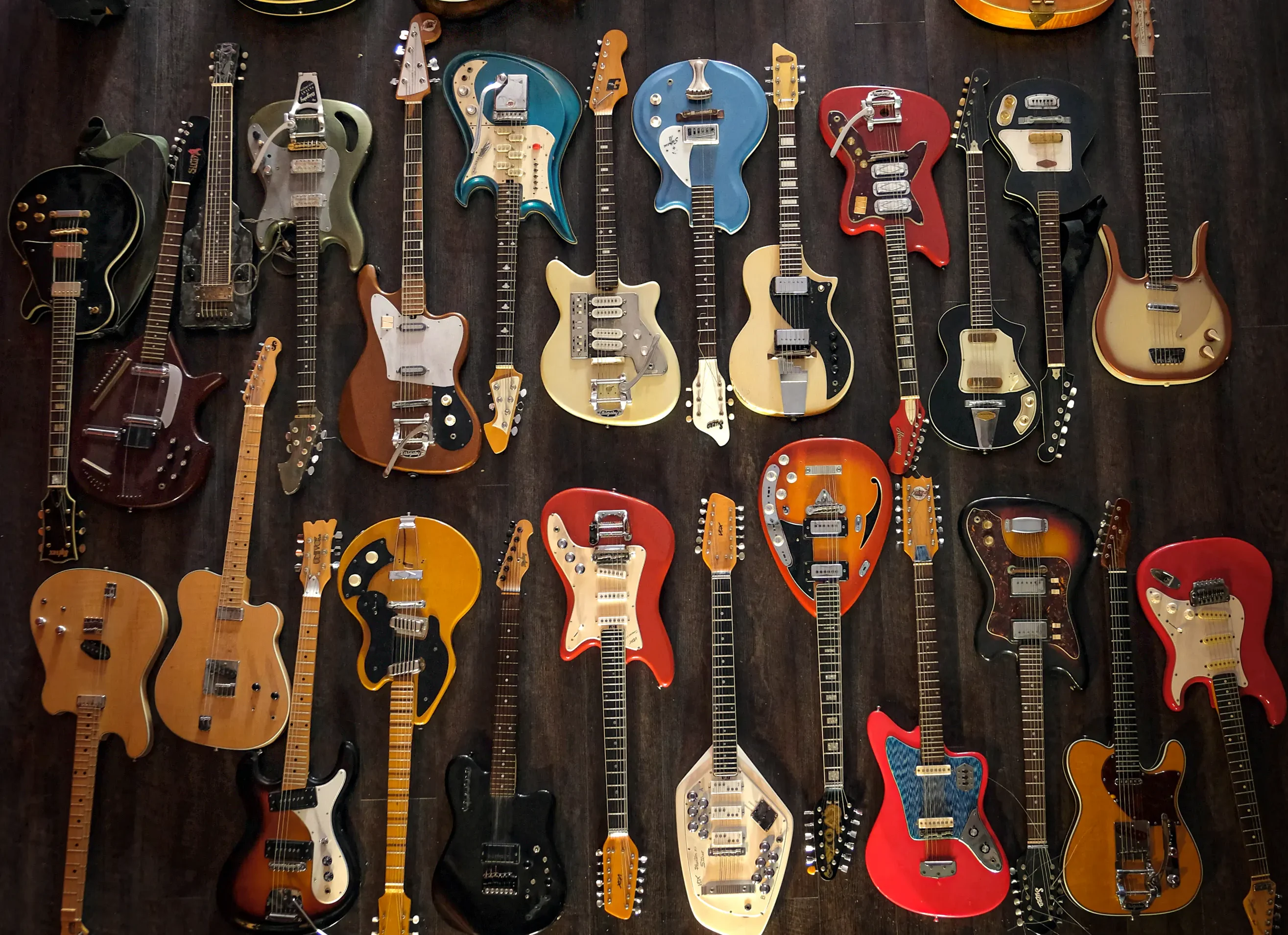
1. An instrument designed from the start as an incomplete, imperfect tool
The electric guitar was built as an inherently incomplete instrument—one that assumes the use of amplifiers and effects from the very beginning. Unlike an acoustic guitar, which produces a finished tone through body resonance alone, an electric guitar requires the signal from its pickups to be amplified and processed through an amp and speaker to reach a usable level. Because of the magnetic characteristics of the pickups, fret placement, string tension and thickness, and the structural connection between the neck and body, the raw signal naturally contains frequency bias and noise. The unprocessed tone is not immediately usable.
These structural limitations pushed guitarists to experiment continuously. From reducing unwanted noise to shaping distortion for more powerful tones, from building dynamic expression in clean tones to designing clearer mids, players have historically treated the guitar as the most imperfect instrument to master. Since the instrument’s “initial tone” is never complete on its own, post-processing became a fundamental requirement rather than an optional enhancement.
As a result, using an electric guitar automatically involves EQ, gain staging, compression, ambience effects, and noise control. This workflow became the blueprint for modern sound design. The tone-shaping, frequency management, and spatial treatment techniques originally developed for electric guitar work in the 20th century later expanded into universal rules for vocals, drums, bass, and virtual synthesizers.
Related Article: Understanding the New Era of Guitar: Clarity over Speed
2. How the Guitar’s Structural Limitations Shaped Modern Mix Engineering

Electric guitars occupy a large portion of the low-mid and midrange spectrum, and distortion increases harmonic content drastically. Because of this, guitars frequently clash with vocals, snares, and synthesizers, causing the entire mix to become muddy if left unmanaged. To solve this, engineers needed clear rules for frequency placement, spectral separation, and what ranges should be removed or emphasized for each instrument.
Through this process, engineers systematized frequency distribution guidelines, inter-instrument spectral roles, high-cut and low-cut standards, multiband dynamic control, and noise-gating practices. Many of the now-common conventions—like “this is where guitars sit, and this is where vocals go”—originated from decades of managing guitars’ dense midrange.
To make lead lines or guitar tones cut through saturated mids, techniques like saturation mixing and post-distortion shaping became standard practice. These approaches were born from solving guitar-related mixing problems, but over time they became the backbone of modern mix engineering across all genres.
3. Imperfect Intonation and Harmonics as the Foundation of Modern Timbre Richness

Electric guitars cannot maintain perfect intonation. Equal temperament and the actual vibration patterns of a string never fully match. Fret placement, string height, string tension, and finger pressure all introduce micro-variations in pitch. These small deviations generate additional harmonics on top of the fundamental frequency, and distortion amplifies them even further. As a result, a single note contains a high amount of information.
Cognitive psychology has shown that people prefer signals with structured complexity over completely simple ones. Higher information density within a single time window is often perceived as “richer,” more engaging, and more satisfying. During the author’s graduate research in audiovisual cognition, similar patterns were experimentally observed—listeners consistently favored sounds containing micro-variations and layered harmonic details over overly clean signals.
Because of tuning inconsistencies, variations in string vibration, and distortion-generated multi-layered harmonics, the electric guitar naturally produces timbres with high information content. This is why a single sustained note never feels static or boring. This characteristic ultimately shaped the modern standard for a “rich tone” in popular music.
4. The Direct Line Between Guitar Harmonics and Synthesizer Detune

Modern software synthesizers—Serum, Sylenth1, Massive, and others—treat detune as a core feature. By layering multiple oscillators and slightly detuning them, synths generate phase interference and harmonic spread, resulting in thick, wide tones.
This behavior mirrors what electric guitars naturally produce. Each string has slight tuning differences, and pitch changes subtly depending on how the player presses the fret. These micro-differences generate phase interactions and harmonics, creating a rich timbre. Synth detune replicates this phenomenon intentionally, making it repeatable in digital environments.
So the thick leads and wide pads of modern pop, EDM, and K-POP are directly rooted in the harmonic behavior of electric guitars. Detune is essentially the digital version of the guitar’s physical imperfections.
5. How Electric Guitar Fingering Shaped Modern Chord Progression Norms
Many of today’s common chord progressions originated from the physical layout and movement efficiency of guitar fingering. Progressions that require minimal hand movement—patterns that feel “natural” on a guitar—became standardized simply because they were easiest to play.
I–V–vi–IV, vi–IV–I–V, and power-chord-based patterns first stabilized in guitar-driven genres such as rock, metal, and pop-punk. These forms later flowed into pop, EDM, K-POP, and hip-hop synthesizer and piano writing. Modern chord grammar is rooted less in piano logic and more in the ergonomic patterns of guitar players.
In essence, what feels efficient on a fretboard became what sounds familiar across global popular music.
6. How Guitar Logic Spread Across Genres and the Music Industry Structure
Guitar-based sound architecture influenced not only genres but also the economic and industrial structures of live music. Band formats became the basic unit of touring, and setups centered on guitar, bass, drums, and vocals created the foundation of global concert stage design. EDM and K-POP performance structures were later built by layering synthesizers, tracks, and samplers on top of this template.
In studio production, the guitar-driven mixing standards—vocal vs. guitar priority, kick-bass separation, midrange management—became universal production guidelines. Even as genres diversified and instruments changed, these original rules continued to be reused, forming the common language of modern music production.
7. The Electric Guitar as the Framework of the Modern Music System
Today’s popular music ecosystem is the accumulated result of the electric guitar’s physical and electrical properties. Imperfect intonation, harmonic complexity, pickup and amplifier-induced noise, the development of sound design to control these issues, guitar-based chord efficiency, and digital detune techniques all originate from solving the guitar’s shortcomings.
The electric guitar played a defining role in establishing the production, mixing, structural, and performance frameworks that modern music still follows. Understanding contemporary pop, K-POP, and EDM sound design and chord systems ultimately requires revisiting the challenges and solutions that arose from handling the electric guitar, the original imperfect instrument that quietly defined the entire musical landscape.
Related Article: Guitar Performance Today: The Shift from Power to Presentation




Leave a Reply