
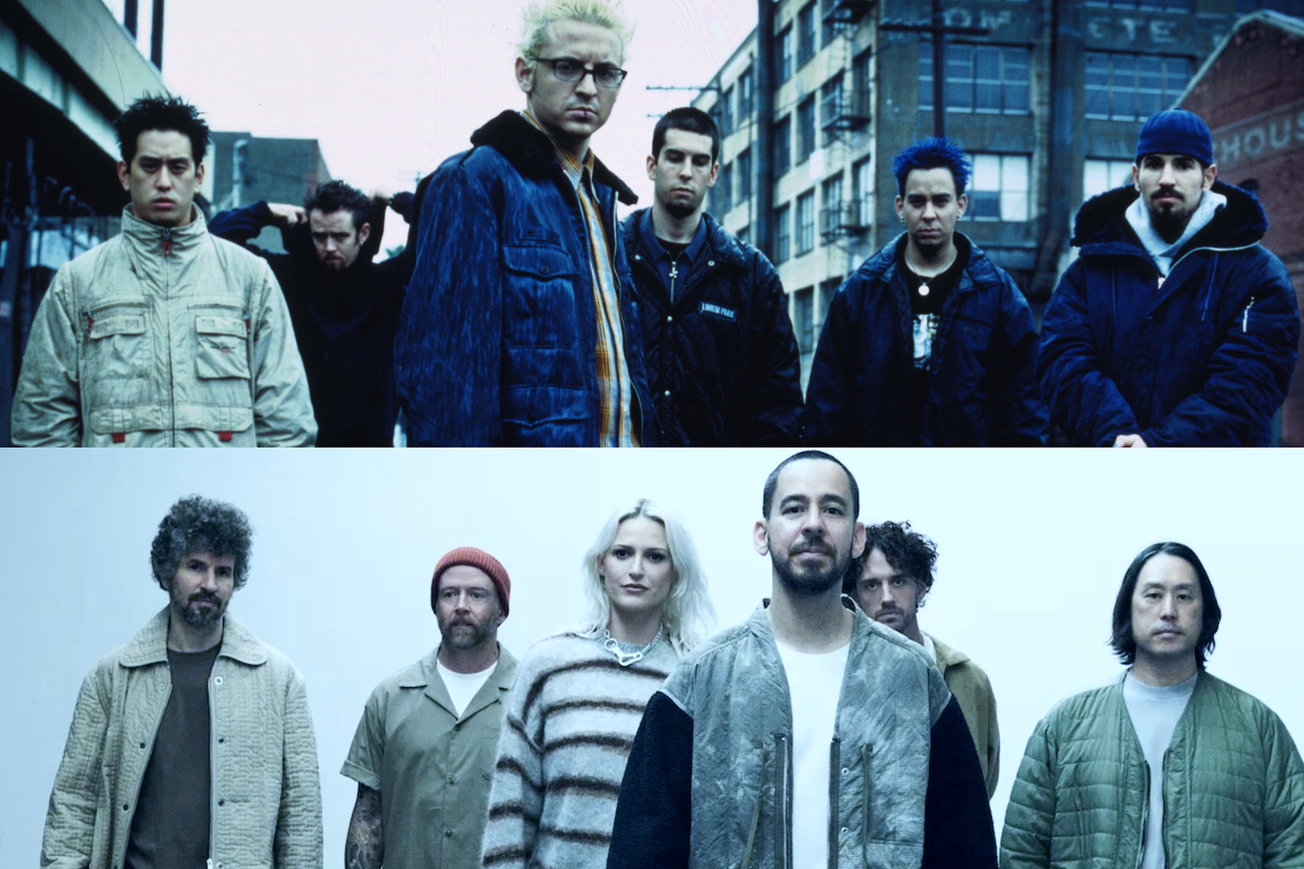
Linkin Park Has Never Released the Same Sound Twice
Linkin Park has never repeated itself. Hybrid Theory (2000) defined the nu-metal era by merging rap and metal into a new hybrid form, while Meteora (2003) expanded the palette with strings, samples, and layered synthetic drums.
Before even moving forward, the band had already shown this mindset with Reanimation (2002), a full remix album that deconstructed their debut and reassembled it through collaborations with hip-hop, electronic, and underground artists. It was more than a remix project—it was a statement that Linkin Park was willing to rebuild its own sound from the inside out.
Minutes to Midnight (2007) stripped back electronics and returned to a rock-band core, while A Thousand Suns (2010) introduced ambient, electronic, and political narratives that reshaped the band’s identity. Living Things (2012) reinterpreted the digital sound of its time with emotional depth, and The Hunting Party (2014) revived their aggressive guitar roots. One More Light (2017), the final album with Chester Bennington, leaned into melody and human warmth.
Each album broke its own formula, ensuring the band never became a product of its time. Their evolution wasn’t about chasing trends but redefining them. Every release sparked debate among fans and critics, but those discussions kept Linkin Park culturally alive. If they had stayed in their early nu-metal comfort zone, they would have faded into nostalgia. Instead, their willingness to rebuild from scratch made them one of the few rock bands to remain relevant for over two decades.
A Band Built on Structure, Not Just Emotion
Despite their reputation for introverted lyrics and powerful expression, Linkin Park has always functioned like a precision-engineered production system. Chester Bennington (vocals), Mike Shinoda (vocals, producer), Brad Delson (guitar), Joe Hahn (samples, visuals), Phoenix Farrell (bass), and Rob Bourdon (drums) each held distinct functional roles.
Producer Rick Rubin once said, “Linkin Park was more like a production team than a traditional band—each member worked in their own studio, and songs were built piece by piece.” This modular approach, prioritizing design over improvisation, enabled their genre-fluid sound.
In 2024, the band rebuilt once again with From Zero, introducing Emily Armstrong as the new lead vocalist and Colin Brittain as drummer and co-producer—marking a full reset of emotion, technology, and structure.
Mike Shinoda: The Starting Point of Linkin Park’s Production Architecture

Mike Shinoda remains the band’s creative engine and technical architect. Coming from a hip-hop background, he merged production logic with live instrumentation long before “hybrid” became a buzzword.
Early on, he built tracks with MPC2000 and Pro Tools; after A Thousand Suns, he transitioned to Ableton Live, adopting nonlinear sequencing as the foundation of the band’s workflow. This allowed Linkin Park to blend electronic, ambient, orchestral, and rock textures with seamless continuity.
But even the most engineered structure needed a human voice to complete it.
Chester Bennington: Transforming Production into Expression

If Shinoda designed the framework, Chester Bennington was the expression that powered it. His ability to move between clean vocals, unclean screams, and melodic grit gave Linkin Park’s hybrid structure its human core. Performances like Given Up and Waiting for the End showcase extremes of rage and vulnerability that few vocalists have ever bridged.
Shinoda once said, “With Chester, you could just throw him an idea and he’d finish it. You didn’t realize how rare that was until it was gone.” Bennington’s voice wasn’t just sound; it was emotion made physical—a raw human signal balancing the band’s technical precision.
Joe Hahn, Brad Delson, Phoenix Farrell, and Rob Bourdon: The Structural Backbone
Joe Hahn defined the band’s early sonic identity through distinctive turntable textures and sampling, later evolving into the visual director behind Linkin Park’s videos and stage design.
Brad Delson provided structural guitar frameworks instead of flashy solos. Phoenix Farrell anchored emotional depth through stable basslines, and Rob Bourdon’s calculated drumming unified the band’s kinetic rhythm system.
Linkin Park’s sound was not the sum of individuals—it was a system of roles engineered to function in perfect cohesion.
“From Zero”: A Full-Scale Reconstruction

The death of Chester Bennington in 2017 brought the band’s journey to a halt. When Linkin Park returned in 2024 with From Zero, it wasn’t nostalgia—it was a full system reboot.

At first, the decision to bring in Emily Armstrong as the new vocalist divided fans. Some said, “Linkin Park can’t exist without Chester,” while others doubted the choice of a female lead. But as the record unfolded, those fears proved misplaced.
Armstrong brought a gritty, raw tone and live intensity that contrasted yet complemented the band’s digital precision. Rather than replacing Chester, she reframed the emotional language he left behind, bridging the band’s past pain with renewed urgency.

Drummer and co-producer Colin Brittain, known for work with ONE OK ROCK and 5 Seconds of Summer, added modern rhythmic dynamics and ambient mix balance. Together with Mike Shinoda, he redefined the band’s sonic weight—cleaner, tighter, but still volatile.
From Zero wasn’t about filling a void; it was about integrating legacy with new perspective. It embodied Linkin Park’s core principle: disassemble, adapt, and rebuild. In doing so, the band turned controversy into evolution, and grief into momentum.
Tracks like Emptiness Machine and Heavy Is the Crown revived the riff-driven aggression of their nu-metal roots, while Casualty channeled hardcore punk textures. Over Each Other leaned toward a pop-alternative structure with melodic accessibility, and Overflow expanded the band’s industrial soundscape with refined electronic layering. Centered on metallic percussion, resonant low-end synthesis, and processed vocal textures, the track embodies Linkin Park’s pursuit of mechanical intensity and production precision. It connects the abrasive dynamics of The Hunting Party with the electronic framework of A Thousand Suns, forming the core of the band’s new sonic architecture under Emily Armstrong’s lead.
Commercially, the album debuted at No. 1 in over ten countries including the U.K. and Germany, and sold 97,000 copies in its first U.S. week. The Emptiness Machine entered the Billboard Hot 100 at No. 27, the band’s highest since New Divide. Across Europe, it even surpassed In the End in chart longevity, reaffirming Linkin Park’s cultural resilience.
Only Musicians That Keep Changing Survive

Linkin Park has never tried to relive its peak. Instead, it continually invents new sonic languages that reinterpret its emotions for each generation. The band’s story is less a discography and more a study in adaptation.
Most artists fear change, but markets and audiences always demand novelty. Debate and polarization aren’t threats—they’re proof of relevance. Whether loved or criticized, being discussed keeps a brand alive.
As music becomes increasingly homogenized, the ability to break form becomes the ultimate differentiator. Linkin Park’s continuous reinvention—breaking, rebuilding, and transforming—defines not only their survival but their ongoing vitality.
In an age where algorithms reward repetition, Linkin Park remains living proof that risk, not predictability, sustains longevity.




Leave a Reply