

Nine Inch Nails cannot be reduced to the role of an industrial rock mascot. Trent Reznor’s work centers on designing how sound is generated, processed, structured, and delivered, rather than simply making a “good-sounding” track. His approach established a framework that later influenced alternative rock, nu-metal, electronic music, and film scoring.
1. Studio Space: How the Working Environment Evolved
1) Le Pig Era (The Downward Spiral, 1994)
The Downward Spiral was recorded at Le Pig, a house on Cielo Drive in Los Angeles that Reznor converted into a studio. The setup was very different from a conventional commercial facility.
- The living room functioned as both the control room and the main recording space.
- Rather than building a formal live room, other rooms in the house were used as recording spaces when needed.
- The house was treated as a flexible work environment, where each room’s purpose could change depending on what was being recorded or edited.
In this phase, the studio functioned as a flexible digital-editing environment, where rooms were assigned new roles depending on the task at hand. The workflow dictated how each space was used, and the layout shifted continually to support recording, processing, and experimentation.
2) Nothing Studios Era (The Fragile ~ With Teeth ~ Year Zero)
From 1995 onward, Nothing Studios in New Orleans became the base for NIN’s work. Here, the studio architecture became fully systematized.
- A large main control room
- SSL 4000 G+ console
- Two Studer A800 24-track tape machines
- Multiple live rooms of different sizes surrounding the main control room
- A converted garage space used as a dedicated drum room
- Upstairs rooms set up as individual programming/edit suites
- Personal work rooms for band members, connected via internal file servers and an Ethernet network for session sharing
At this stage, the studio was clearly divided by function. Reznor could adjust the production environment on a project-by-project basis by reallocating how these rooms and systems were used.
2. Production Workflow: Analog–Digital Hybrid System
Reznor’s production is consistently centered around digital sequencing, even when analog gear is heavily involved.
1) Le Pig Phase
- Opcode Studio Vision was used as the core sequencing and editing platform.
- Guitar, vocals, synths, and noise sources were recorded directly into the computer.
- Editing and arrangement determined which segments stayed in the song and which were discarded.
Recording functioned more as a source-capture stage than a final performance stage. The actual structure of the song was established later inside the DAW through cutting, moving, and layering.
2) Nothing Studios Phase (The Fragile and after)
At Nothing Studios, analog gear and digital tools were integrated into a consistent hybrid system.
- Audio flowed from the SSL 4000 into Pro Tools as a multitrack digital environment.
- Analog compressors and EQs were used before tracks returned to digital editing.
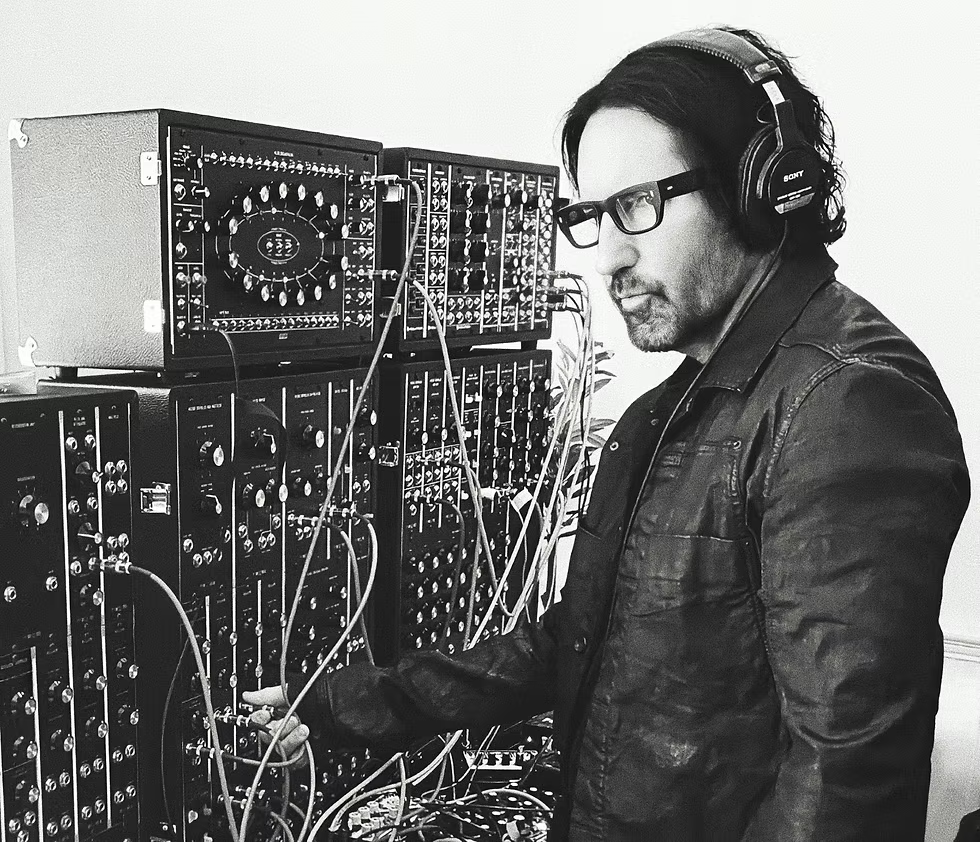
- Samplers, modular synthesizers, software synths (such as Reaktor), and tape machines were combined in a single routing scheme.
- The main control room acted as the core hub, feeding and receiving signals from the surrounding live rooms and individual work rooms.
This setup anticipated a now-standard concept: analog tone and coloration managed inside a digital editing and sequencing framework. NIN implemented this idea at album scale before it became common practice across the industry.
3. Composition and Sound Source Creation
1) Starting Points: Texture and Pattern First
Reznor’s writing process usually follows two types of starting points:
- Sketching chords and melodies on piano or guitar
- Building rhythmic loops or noise/texture patterns first, then constructing the song around them
When a song begins on piano, most of the original sound is replaced later. The chord structure, vocal line, and section layout are kept, while the actual timbres are swapped out for guitars, synths, processed samples, or combinations of all three.
When a track starts from noise or rhythm, the core of the composition becomes texture, pattern, and impact.
In practice, the process often looks like this:
- Cutting a drum loop into detailed fragments, adding small variations, and using that as the structural backbone
- Recording a guitar riff, then running it through distortion, filters, bit crushers, and resampling it until it functions like a synthesizer layer
- Creating background noise layers from machine sounds, metal hits, or environmental recordings and assigning them the role of long-term tension in the arrangement
This method becomes more precise as the discography progresses from Pretty Hate Machine to Broken, The Downward Spiral, and The Fragile.
2) Source Creation: Recording, Sampling, and Reshaping
Reznor’s sound sources are generated through three main routes.
- Live Performance Recording
- Recording drums, guitars, bass, and vocals in multiple takes
- Changing mic placement, preamps, and compression settings to capture several tonal versions from the same performance
- Sampling and Field Recording
- Capturing non-musical sounds such as machinery, doors, metal impacts, factory ambience
- Cutting these into fragments and turning them into drum layers, transitions, or background textures
- Resampling
- Sending recorded guitars, vocals, and synths back through effects units, consoles, and tape machines
- Sampling the processed result and using it as a new instrument
A large portion of the drums and noise layers on The Downward Spiral and The Fragile comes from these resampling and reprocessing steps. Very few sounds go straight from a single recording pass into the final mix; most are reshaped multiple times.
4. Editing and Sequencing: Micro-Level Reassembly
As DAW usage increased, Reznor’s advantage became most obvious in the editing phase.
- Drum loops are split into kick, snare, hi-hat, and noise hits.
- Each element receives different compression, EQ, and spatial processing.
- Timing is adjusted not only at the beat level, but in millisecond-scale nudges to create specific grooves.
- Repetition is broken by constant micro-variation in pitch, decay, velocity, and panning.
Practical examples include:
- Pushing the snare slightly late to add weight and impact.
- Making each hi-hat hit slightly different in length, tone, and position so the loop never becomes a flat, mechanical pattern.
- Using noise hits and reverse samples as section change markers instead of conventional drum fills.
The violent character of tracks like “Wish” or “March of the Pigs” owes a lot to this detailed editing and timing work, not only to distortion or loudness.
5. Layering and Frequency Design
NIN’s mixes sound dense and abrasive, but the internal structure is tightly organized.
- Guitars
- Clean tone, heavy distortion, mid-forward “sawing” tone, and low-end support tone each occupy separate tracks.
- Synths
- Dedicated bass synths, midrange rhythmic synths, and high-frequency noise/lead layers with distinct functions.
- Vocals
- Main vocal, distorted versions, whisper layers, and double-tracking for choruses.
When stacking these layers, the following practices are typical:
- Assigning specific frequency ranges to each layer to avoid overlap.
- Aggressively cutting unnecessary low or high content.
- Applying heavier compression to bands that carry perceived attack (for example, 2–4 kHz), and keeping other bands more open.
The overall result feels chaotic on the surface, but the system underneath is more like a frequency-based division of labor. This approach later appears clearly in the work of Linkin Park, Bring Me the Horizon, and many modern rock/metal productions.
6. Dynamics, Space, and Compression
Reznor does not rely on simple gain increases to achieve intensity. His albums use a combination of dynamic contrast, density, and spatial control.
- Dynamic contrast
- Quiet and loud sections are contrasted not only in volume, but in the number of instruments, the number of active frequency bands, noise content, and reverb length.
- Compression strategy
- Bus compression is combined with individual track compression.
- Drum busses are kept tight and controlled.
- Guitars and synths are often side-chained or multi-band compressed to avoid fighting with the vocal.
- Spatial design
- Even when there is heavy use of reverb and delay, certain instruments stay dry to maintain focus and contrast.
- Excess reverb is removed when it blurs impact; the mix often feels like it is moving forward rather than spreading indefinitely.
“The Day the World Went Away,” for example, feels massive, but the effect comes more from changing density, noise, and spatial parameters than from a simple volume increase.
7. Production Evolution by Album
Pretty Hate Machine (1989)
- Synth-pop structures with integrated guitars.
- Drum machines, analog synths, and samplers as the main engine.
- Vocals and guitars are simpler; rhythm and synths carry most of the structural weight.
Broken (1992)
- Increased guitar and drum aggression.
- Short, compressed song structures, loop-based riffs.
- Noise and distortion treated as active rhythmic elements.
The Downward Spiral (1994)
- Experimental modular setup at Le Pig.
- Tape, samplers, and digital editing combined in a hybrid system.
- Noise, ambience, processed drums, and layered vocals interwoven into complex arrangements.
The Fragile (1999)
- Full exploitation of the Nothing Studios infrastructure.
- Extensive work with phase, loops, and texture experiments.
- Static sources layered and altered in small increments to sustain tension.
- Spatial and frequency design pushed to an extreme level of detail.
With Teeth (2005), Year Zero (2007)
- Pro Tools-centered digital workflow fully established.
- Modular synths, analog compressors, and digital editing integrated into a routine production system.
- Tracks like “The Hand That Feeds,” “Only,” and “Survivalism” function as templates for modern rock productions that blend guitars and electronics.
8. Impact on the Wider Music Industry
Reznor’s methods affected three key areas.
- Unit of work
- A song is no longer framed primarily as “lyrics–composition–arrangement.”
- Instead, it is framed as sound design, signal flow, and process management.
- Definition of the producer role
- Performance, arrangement, sound design, and engineering are not strictly separated.
- The producer can oversee and operate the entire chain from input to final print.
- This “full-stack producer” model later becomes common in nu-metal, rock, EDM, and pop.
- Industry and business models
- Through The Null Corporation, NIN experimented with digital distribution outside the major-label framework.
- This provided an early example for bands and solo artists considering “self-production + self-distribution” as a realistic option.
Related Article: Reinventing Survival: How Linkin Park Stayed Alive Through Evolution
9. Film Scoring and Later Expansion
In Reznor’s collaboration with Atticus Ross, the same production logic is applied in a different domain.
- Rhythm and noise play a smaller role; texture, frequency density, and spatial structure become central.
- Traditional melody and orchestration are replaced or supplemented by cue-specific sound design aligned with scene pacing and psychological tension.
- The Social Network, Gone Girl, and The Girl with the Dragon Tattoo are key examples of this approach in film.
Layering, sampling, dynamic control, and spatial decisions developed in NIN’s band work carry over directly into these scores, proving that the underlying production system is adaptable across formats.
NIN’s Contribution in the Music Industry
Trent Reznor’s output is difficult to summarize as “great sound” or “aggressive production.” The core contribution lies in combining:
- Studio space design
- Analog–digital signal flow
- Texture-based composition
- Recording, sampling, and resampling
- Editing and sequencing
- Frequency- and layer-based mix structure
- Project-level system reconfiguration
These elements form a coherent production system that has influenced how later generations of producers in rock, metal, electronic music and film scoring think about making records.




Leave a Reply